
The Most Beautiful Grass You’re Not Growing Yet
Some plants earn their place in a garden by being useful. Hakone grass earns its place by being gorgeous, and honestly, that’s more than enough reason to plant it.
It’s easy to get swept up in the practical side of planting, pollinator value, drought tolerance, how hard-working a plant is across the seasons. All of that matters, and it’s exactly the kind of thinking that shapes most of what goes into a garden design. But every so often it’s worth remembering that a garden is also just supposed to be beautiful, and some plants are there simply because nothing else does quite what they do. Hakone grass is one of those plants.
Meet Hakonechloa macra
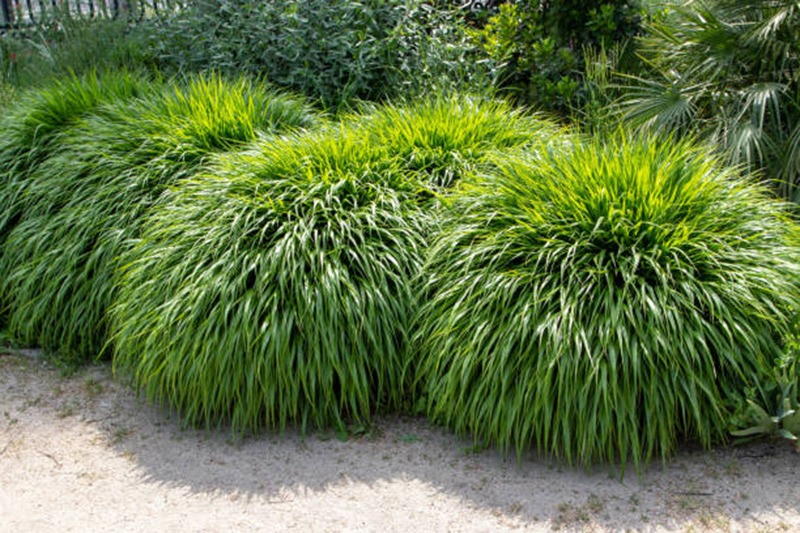
Hakone grass, properly Hakonechloa macra, though nobody’s going to judge you for just calling it Hakone, is one of those rare grasses that actually wants to grow in shade, when almost every other ornamental grass is out there sulking for full sun. Its arching, cascading blades all fall the same way, like a little green waterfall that’s decided to grow sideways instead of down. Plant it in a mass and the effect is genuinely mesmerising, catching the light and moving with the smallest breath of wind.
Depending on the variety, the foliage runs from soft lime-green through to bright gold, deepening into copper and russet tones as autumn sets in. It’s one of those plants that quietly changes character through the year without you ever having to do anything to it ,which, frankly, is exactly the kind of low-effort, high-reward planting everyone secretly wants more of.
There’s real variety within the species too, so it’s worth knowing a few names. ‘Aureola’ is the one you’ll see most often, golden-chartreuse blades with a thin green stripe running down the centre, bright enough to genuinely light up a dark corner. ‘All Gold’ does exactly what it says, running a warmer, richer yellow all season. ‘Alboaurea’ brings cream and gold variegation into the mix, while ‘Beni-kaze’ stays green through summer before flushing deep red as the weather cools. However you slice it, there’s a Hakone grass for whatever tone you’re trying to hit in a border, cool and calm, or warm and glowing.
Where it actually comes from
The name gives it away if you know where to look: Hakone grass takes its name from Mount Hakone, in the mountains of central Japan, where it grows naturally on damp, rocky slopes and in the dappled light of woodland edges. It’s not a plant that’s been bred or fussed into liking shade, shade and cool, moist ground are simply where it’s always lived.
That matters more than it sounds like it should. So much of gardening well comes down to matching a plant to the conditions it actually evolved for, rather than fighting it into a spot it was never built for. Hakone grass isn’t tolerating shade as a compromise , it’s thriving in exactly the sort of dappled, sheltered, moisture-retentive ground it’s always called home.
Why it makes so much sense in a British garden
Which brings us to the reason it’s such a sensible choice this side of the world: a shaded British border, on the fringes of a tree canopy, or maybe sheltered by a garden wall or fence that keeps the worst of the midday sun off, is a remarkably close match to a Japanese woodland slope. Dappled shade, soil that holds a bit of moisture without turning to a bog,that’s Hakone grass’s native habitat, more or less transplanted to your garden.
Give it humus-rich, moisture-retentive soil, a spot out of scorching afternoon sun, and it will quietly get on with looking wonderful for years, slowly building into soft, cascading clumps without any fuss. It pairs beautifully with hostas, ferns, and heucheras, classic shade-garden companions that share its taste for cool, damp ground,and works just as well as underplanting beneath a small tree, edging a shaded path, or spilling gracefully over the side of a container.
It’s about as undemanding as ornamental grasses get, too. There’s no feeding needed once it’s established in the ground, no real pest or disease problems to worry about, and slugs, famously fussy about very little tend to leave it well alone. The only real maintenance is an annual tidy: cut the old foliage back hard in late winter or very early spring, just before the fresh growth pushes through, and it’ll reward you with a completely clean flush of colour for the year ahead. In milder gardens the old foliage can even be left over winter for a bit of structure and shelter, then cleared in spring once the worst of the cold has passed.
It’s slow to establish and slow to spread, a virtue as much as a limitation. Unlike some ground-cover grasses that need constant reining in, Hakone grass builds its clumps gradually, so it stays exactly where you put it rather than muscling out its neighbours. That makes it a genuinely low-maintenance choice for a shaded border, not just a pretty one.
How to use it well
The single best thing you can do with Hakone grass is give it somewhere it can cascade. It’s at its most striking when it’s allowed to spill over the edge of a raised bed, down a low retaining wall, along the lip of a container, or softening the hard edge of a step or path. Planted flat in an open bed it’s still lovely, but it’s the cascading habit that really sets it apart from almost every other shade-loving plant, and it seems a shame not to use it.
Grouping matters too. A single specimen of Hakone grass is pleasant enough, but it comes into its own planted in drifts of three, five, or more, where the individual cascades merge into one continuous, rippling sweep of foliage. In a woodland-style border, that’s often far more effective than trying to give it a solo, feature-plant moment let it do the quiet, textural work alongside hostas and ferns rather than asking it to be the star on its own.
It’s just as happy in a container as it is in the ground, which makes it a useful plant even for a small, shaded courtyard or balcony that doesn’t have a border to speak of. A single large pot, planted with nothing but Hakone grass, is a genuinely elegant thing to have sitting by a shaded doorway or on a north-facing patio that struggles to support much else.
A native substitute worth knowing: Luzula sylvatica
If you love the idea of Hakone grass but want something a little tougher, faster to establish, or more at home in a wilder, native-leaning scheme, it’s worth knowing Luzula sylvatica, greater woodrush. It’s not a true grass (it’s a member of the rush family), but it does a similar job in a shaded border: a dense, evergreen mound of glossy, dark green, strap-like foliage that thrives in exactly the same dappled shade and moisture-retentive soil that Hakone grass loves.
Where Hakone grass is slow, delicate, and a little precious, Luzula sylvatica is fast, tough, and thoroughly unbothered, it’ll cope with deeper, drier shade, spreads more readily to knit together as decent ground cover, and stays evergreen through winter rather than dying back, so it’s doing a job in the border twelve months of the year. It’s also genuinely native to British woodlands, which makes it a natural fit if you’re building a scheme with a wilder, more naturalistic feel, or if the site is simply a bit too shady, dry, or exposed for Hakone grass to settle happily.
Neither plant is a straight swap for the other,Hakone grass wins on sheer elegance and seasonal colour change, Luzula wins on resilience and evergreen structure but knowing both means you’re never stuck for a texture plant in shade, whatever the exact conditions on the day.
A plant worth growing for its own sake
Hakone grass isn’t a plant I’d sell you on the back of what it does for the local wildlife, it’s simply one of the most beautiful pieces of texture and movement you can bring into a shaded border. In a naturalistic planting scheme, it’s exactly the kind of plant that earns its spot through sheer quality of form: soft, textural, endlessly photogenic, and doing something genuinely different to almost anything else that’s happy in shade.
If you’ve got a dappled, sheltered corner that’s never quite known what to do with itself, Hakone grass might just be the answer.
Here is an instagram link showing, me in the rain alongside Hakonechloa macra
