
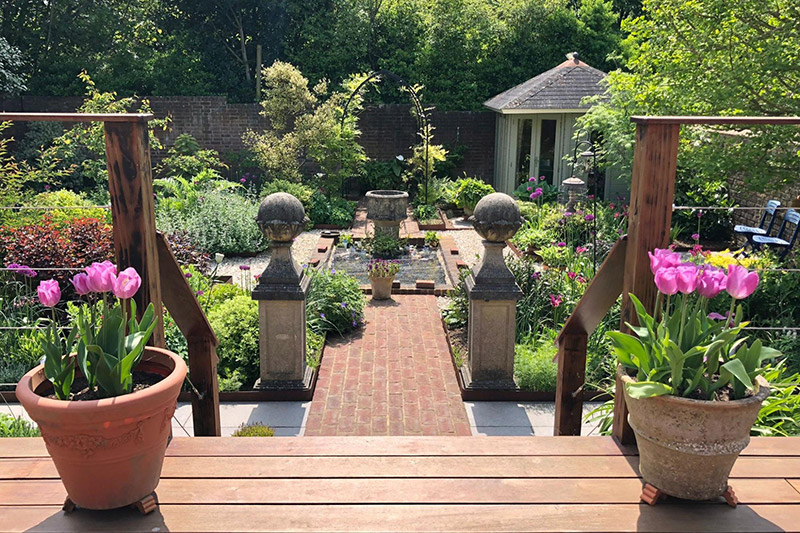
From Dirty Pool to Dream Garden: The Complete Redesign of a Wilbury Crescent Garden, Hove
Some gardens start as a blank canvas. This one started as a swimming pool nobody wanted to look at anymore.
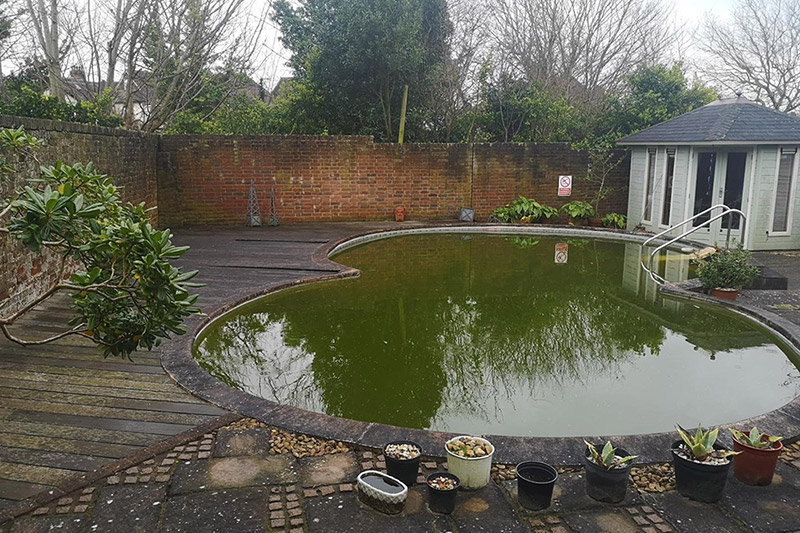
Tucked behind a south-facing wall on Wilbury Crescent in Hove, this garden had spent years being defined by water that wasn’t being swum in. By the time the owners, Neil and Rodger, called us in, the pool had gone from “occasional summer luxury” to genuinely a bit of a dirty mess, stagnant, tired, and doing absolutely nothing for a garden that deserved better. Sometimes the most honest place to start a redesign is admitting the thing in the middle of it has to go.
The brief: bring the garden back to life
Neil and Rodger had just finished an internal refurbishment of the house, and the garden was the obvious next chapter. They wanted somewhere to actually walk around and admire,not stare at from the kitchen window and think “one day.” The garden had been sterile for so long, dominated by a pool that had stopped earning its keep, and they wanted life back in it: colour, movement, wildlife, the lot.
The project landed during lockdown, which, if you were doing any kind of home improvement in that particular stretch of time, you’ll know came with its own logistical flavour of chaos.
The challenge: what do you actually do with a dead pool?
Here’s the bit that doesn’t photograph well but matters more than almost anything else in the whole project: getting rid of a swimming pool properly.
It would have been easy and lazy to just tip some soil over the top and call it done. That’s how you end up back on site eighteen months later explaining to a very unhappy client why their lawn has developed a sinkhole. Instead, we took the liner out, broke through the base to get proper drainage sorted, and then rebuilt the ground from the bottom up: a layer of stone and shingle first, then sub-soil, then finally the good stuff, topsoil the rest of the garden could actually grow in. Slow, unglamorous, absolutely essential. This is the artisan craftsmanship nobody claps for, but it’s the difference between a garden that looks good on hand-over day and one that still looks good in five years.
Once we were through the pool debris and back to real ground, the soil needed time to settle and recover before it could support the kind of planting design Neil and Rodger were after, another reason the “slow and unglamorous” phase mattered as much as anything that came after it.
Designing around a walled, south-facing garden
A south-facing walled garden is a genuinely lovely thing to be handed as a garden designer: good light, good shelter, and walls that can carry planting vertically as well as horizontally. As always, the design started life as a hand-drawn plan rather than a computer rendering. For a garden with this much history sitting under the surface, old pool edges, changed levels, a slightly unpredictable subsoil, sketching it out by hand forces you to really think through the proportions and sightlines before anything gets marked out on the ground.
The layout kept things walkable and legible: paths that actually take you somewhere, seating that catches the sun where the sun actually falls, and structure that reads clearly whether you’re looking at it from the kitchen window or standing right in it.
The hard landscaping: proper materials, properly done
This is where the “artisan craftmanship” bit stops being a slogan and starts being visible. The palette was kept restrained and coastal, chosen to sit comfortably with the setting rather than compete with it:
- Metal edging to hold crisp, clean lines between planting and path,no fuss, no wandering borders, just a confident full stop wherever one was needed
- Flint gravel, which nods to the Sussex coast a few streets away and ages far more gracefully underfoot than plain paving ever does
- A Balau hardwood deck for the main seating area, warm, weather-resistant, and built to earn its keep for decades rather than a couple of summers
- Scorched, upright timber accents, used sparingly as a vertical, almost sculptural feature, dark, textural, and the kind of detail that makes visitors stop mid-sentence and ask what it is
None of this is about showing off for its own sake. Every material was chosen to do a specific job in a specific spot, which is really the whole definition of craftsmanship, not decoration for decoration’s sake, but the right thing, in the right place, done properly. It’s the kind of detailing that separates a garden someone had “landscaped” from a garden someone actually designed.
The metal edging and flint gravel work together to keep the whole space feeling calm and clean rather than fussy, while the Balau deck and scorched timber bring warmth and a bit of drama into the mix, proof that hard landscaping doesn’t have to be an afterthought bolted onto a planting scheme. Done well, it’s a co-star, not scenery.
Before and after: what actually changed
It’s worth pausing on just how different this space is now compared to where it started. Where there was once a smelly, algae swamp taking up most of the usable garden, there’s now a walkable route through the space, somewhere you naturally move through rather than just look at from one fixed spot. Where the old layout offered one view (the pool, from the house), the new one offers several: a seating area that catches the afternoon sun, planting that draws the eye along the walls, and paths that give you a reason to explore rather than just admire from a distance.
That shift, from a garden you look at, to a garden you’re actually in, is often the single biggest transformation in a redesign like this, and it rarely gets talked about as much as the plant lists and materials do.
The planting: season-long, and built for wildlife
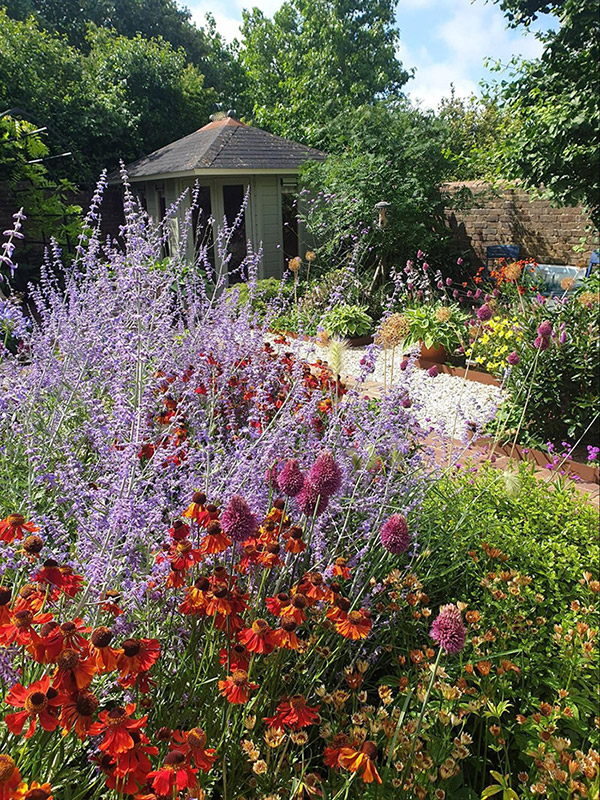
Hard landscaping gives a garden its bones. Planting is what makes it breathe. The scheme here was built for season-long interest rather than one glorious fortnight in June, structure holding things together through the quieter months, a proper spring flush, high-summer colour, and grasses and seed heads carrying the garden into autumn.
Just as importantly, Neil and Rodger wanted wildlife back in a garden that had been, frankly, a bit of a dead zone for it. Pollinator-friendly planting threaded through the whole scheme means bees, birds, and butterflies now have a reason to visit a garden that used to offer them nothing but chlorinated water.
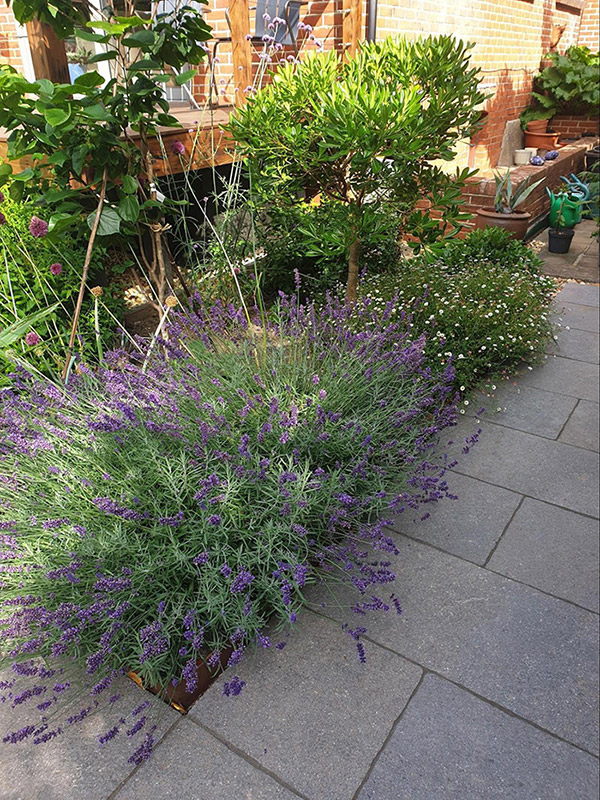
The plant list itself does a lot of the storytelling. An Amelanchier was brought in as the small specimen tree, giving the garden a bit of height and structure without ever overwhelming a space this size. Wisteria was trained up and over a pair of arbors, so in a few years the walk through the garden will happen under a proper flowering canopy rather than just past one. Pittosporum adds the evergreen backbone that keeps the whole scheme looking dressed through winter, while Viburnum fills in with reliable structure and scent along the walls.
For colour and movement, Rudbeckia, Perovskia, and Erigeron carry the garden through summer with a proper wash of yellow, purple-blue, and daisy-white, while Hakonechloa (Hakone grass) threads through the borders for softness and movement wherever it’s planted. Hosta does the shade-loving, textural work in the cooler corners the wall creates. And for the earliest colour of the year, tulips and daffodils push up through the borders every spring, a proper reminder that the garden’s alive again long before anything else has got going.
A south-facing wall behind it all helps enormously too, it’s a suntrap for a good chunk of the day, and the planting was chosen to make the most of that rather than waste it on anything too shade-loving.
Garden management: a partnership, not a one-off
Neil and Rodger are keen gardeners in their own right, so this was never going to be a “hand over the keys and disappear” situation. We provide ongoing garden management advice and aftercare whenever they need it, which is exactly how a garden like this should work, a design that’s built to be lived in and looked after, not just admired once and left to fend for itself.
As their own words put it:
“Owen came up with the perfect garden design for our south facing walled garden.”
High praise from two people who spent years staring at a swimming pool they’d rather forget.
Not the first pool, and probably not the last
This wasn’t our first swimming-pool-to-garden transformation, and it won’t be the last another Hove family garden went through a similar journey, proof that “we’ve got an unused pool and no idea what to do with it” is a more common starting point than people think, and a genuinely exciting one to design from.
Small business, big transformation
We’re not a big company. We’re a small business doing big things, one garden at a time, which means every project, this one included, gets proper hands-on attention from start to finish, not a project manager juggling twelve sites at once. That’s how a dirty, unloved swimming pool ends up as a walled garden Neil and Rodger actually want to spend their evenings in.
If you’ve got a garden that’s stuck being defined by what used to be, a tired pool, an old patio, a layout that’s simply stopped working, get in touch and let’s talk about what it could become instead.
