
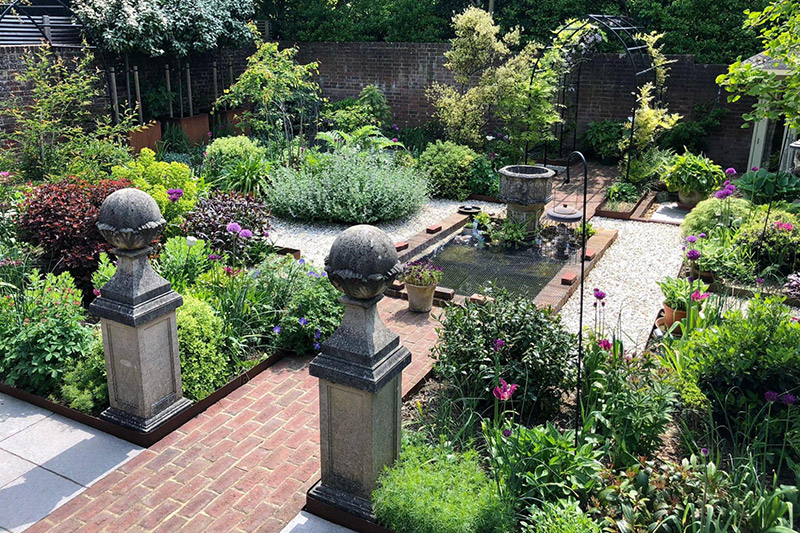
You’ve stood at the back door with a cup of tea, looked at the patch of lawn, the wonky shed and the fence that’s seen better decades, and thought, “Right. Something needs to happen here.” Then the big question lands: do you call a garden designer, a landscaper, or both?
If you’re in Hove or Brighton, you’ve probably already noticed that nobody’s garden here is straightforward. We’ve got sea wind, chalky soil, steep slopes, tiny courtyards, tall Victorian walls and the occasional seagull with opinions. So let’s untangle who does what, and when you need which.
The short version
A garden designer works out what your garden should be. A landscaper builds it.
Think of it like an architect and a builder. One draws the plan, the other turns the plan into bricks, paving and soil. Most of the time they’re two different people with two different skill sets, and they need to talk to each other a lot.
At PurelyPlanting, I do both, and I’ll explain why that’s rather handy in a moment. First, the details.
What does a garden designer actually do?
Here’s the thing most people get wrong: garden design is not just choosing pretty plants. Plants are the bit everyone loves, but they come late in the process, like icing on a cake that’s already been carefully baked.
A designer starts much earlier, by asking questions that sound simple and turn out to be gold:
- How do you actually use your garden? Morning coffee, kids and footballs, long summer suppers?
- Where does the sun land at 9am, at 2pm, at 7pm?
- What can you see from the kitchen window, and what would you rather not see?
- How much time do you honestly want to spend maintaining it? (Be truthful. Nobody is judging.)
- What’s worth keeping? That old apple tree might be the best thing out there.
From those answers a designer shapes the whole space: the layout, levels, proportions, materials, routes through the garden, views, planting and lighting. It’s a bit like interior design, a bit like architecture and a lot like storytelling.
What does a landscaper do?
A landscaper is the person with the muscle, the machinery and the know-how to build the thing. Typical landscaping jobs include:
- Ground clearance and excavation
- Drainage (unglamorous, but absolutely vital, especially on Brighton’s clay pockets and sloping plots)
- Patios, paths, steps and terraces
- Retaining walls and fencing
- Raised beds, pergolas and structures
- Turfing and preparing planting areas
Good landscapers know how materials behave in real life. They know what survives a salty south coast winter and what quietly falls apart. That knowledge is priceless, and you can’t get it from a drawing board alone.
Can’t a landscaper just design it too?
Sometimes, yes. Plenty of landscapers are talented designers, and plenty of designers get involved in the build. The line between the two is blurrier than the job titles suggest.
What matters is what you actually get at the end of the conversation. If you’re considering a landscaper for the design side, ask them:
- Can I see some design work as well as finished photos?
- Will I get a scaled plan before the digging starts?
- Will the planting and materials be properly specified, or is it “we’ll see how it looks on site”?
A design that exists only as a chat over the garden fence is not a design. It’s a hopeful idea. Hopeful ideas get expensive when concrete is involved.
Why not just start building?
Because gardens built one decision at a time tend to feel like it. Patio by the back door. Path down the side. Shed at the bottom. Plants squeezed into whatever scraps of space are left over.
None of those choices is wrong alone. The trouble is they never met each other.
A properly designed garden flows. The terrace is sized to suit the house. The path leads somewhere on purpose, and you want to follow it. The view from the kitchen window is framed rather than ignored. The materials get along. It feels like one place instead of a collection of separate projects, and that is the difference between a garden you walk through and a garden you actually want to live in.
The planting question
Here’s where I get properly excited. A landscaper can absolutely plant things, and plant them well. But planting design is a different craft. It’s about how plants grow, mingle, flop, seed about and change through every season over years, not just how the border looks on the day the pots go in.
When I plan planting, I’m thinking about:
- Mature height and spread (that cute little shrub will not stay little)
- Soil, aspect and drainage
- Wind and salt exposure
- Flowering times and seasonal overlap
- Winter structure, because a garden shouldn’t switch off in January
- Texture, repetition and colour
- Wildlife value, because bees and butterflies are lovely company
- How much maintenance it needs
My style is naturalistic and loose, in the spirit of the great Dutch and English plantspeople. Think soft grasses moving in the breeze, perennials weaving into each other, and a garden that looks beautiful even when it’s gently messy.
Even within a few streets, conditions swing wildly. A sheltered walled garden in central Brighton can grow plants that would sulk and shrivel on an exposed Hove seafront terrace. Choosing the right plant for the right place is half the magic.
Who should you call first?
For a full garden makeover, speak to a designer first. Always.
Imagine asking three landscapers to quote for the same garden with no plan. One assumes porcelain paving. Another prices natural stone. One allows for serious groundworks, another assumes the soil will behave itself. You get three wildly different numbers and no clue which is fair, because nobody was pricing the same garden.
With a design and specification in hand, every contractor prices exactly the same job, and you can compare like with like. It saves arguments, surprises and a fair few grey hairs.
When can you skip the designer?
You don’t always need one. If the job is simple and you know exactly what you want, call a landscaper directly. Swapping a patio like for like, putting up a fence, repairing a path or laying a lawn doesn’t need a full design process.
But the more complex, large or expensive the project gets, the more design earns its keep. Changing levels? Reorganising everything? Mixing materials? Adding lighting, big planting schemes or a whole new layout? Or maybe you just aren’t sure what you want yet? That’s when a designer pays for themselves.
Here’s where doing both comes in handy
In a lot of garden projects, the designer and the landscaper are two separate people. That can work beautifully, but it does mean there’s a gap between the drawing and the digging, and gaps are where things go wrong.
Because I design and landscape, I’m there on site as the garden takes shape. That changes everything.
Found a surprise slab of old concrete under the lawn? I can adjust the plan on the spot. Does that wall look better two inches to the left once you’re standing in the actual space? I’ll move it, right then. Did the afternoon sun fall differently than we expected? I can tweak the seating position before the paving goes down.
Gardens never behave exactly like drawings. Real soil, real levels and real light always throw up little surprises. Having the person who designed the garden standing in it means quick decisions, no waiting for emails to bounce back and forth, and a finished garden that matches the original vision. You can see how this works on a real project in one of my recent Brighton garden transformations.
What about the cost?
Design and landscaping are two parts of one budget. The design fee covers developing and documenting the garden before a spade goes in. The landscaping budget covers building it: labour, materials, machinery, groundwork and all the rest.
The best move is to be upfront about your overall budget early. There’s no point dreaming up a £100,000 garden if the build budget is £30,000. A good designer designs to your budget from day one, so the plan is something you can genuinely afford to build, not a beautiful drawing that ends up in a drawer.
Is a designer really worth it?
For anything substantial, I think so, and not just for the pretty plan. Once foundations are poured, walls are built and paving is down, changing your mind gets expensive very quickly. Design lets you make those mistakes on paper, where an eraser is cheaper than an excavator.
It also turns up ideas you’d never think of yourself. Maybe the seating area works better at the bottom of the garden where it catches the evening sun. Maybe turning the layout on a diagonal makes a narrow Hove terrace feel twice as wide. Maybe a single well-placed tree hides the neighbour’s extension and becomes the view from your kitchen sink. Small decisions like these change how a garden feels every single day.
The best gardens come from teamwork
It was never really designer versus landscaper. A beautiful design still has to be built well, and the finest craftsmanship in the world can’t rescue a layout that doesn’t work. Vision and construction need each other.
Whether you’re in Hove, Brighton or somewhere further afield, if you’re dreaming about a new garden, I’d love to hear about it. Tell me about your space, your soil, your wind and your wishes, and we’ll work out whether you need a full design, a build, or the whole lot together. You can get in touch here to start the conversation.
Quick FAQs
What’s the main difference between a garden designer and a landscaper?
A designer plans the layout, materials and planting. A landscaper builds it. Some people, like me, do both.
Do I need a design before getting landscaping quotes?
Not always, but for a full redesign it makes quotes far easier to compare.
Can you recommend or work with a landscaper?
I do the landscaping myself, so you get one person from the first sketch to final planting.
