
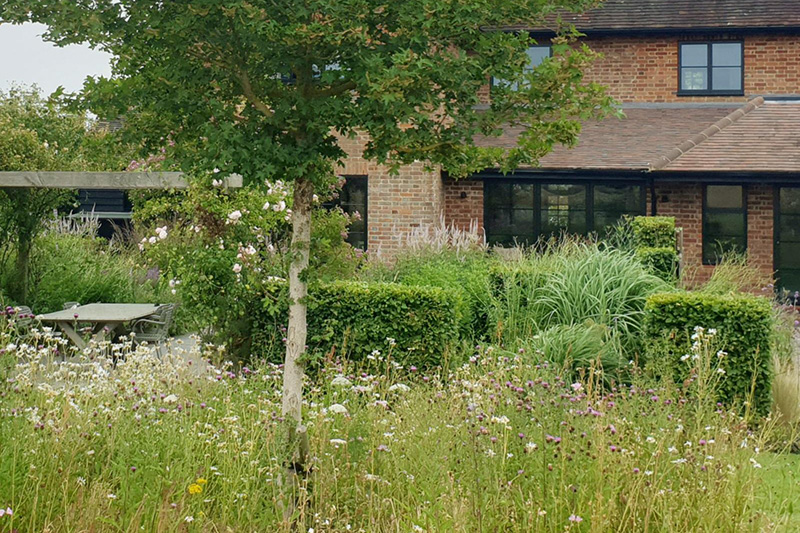
Search for a garden designer in Brighton or Hove and you will find plenty of good ones. What is harder to find is a clear explanation of what “bespoke” actually means in practice. This article sets out how I work at PurelyPlanting, what 22 years of designing and building gardens has taught me, and why I deliberately avoid following whatever is fashionable this year.
What bespoke actually means
For me, bespoke means the design starts from the site, not from a catalogue of favourite details. Every garden begins with the same questions: which way does it face, where does the wind come from, what is the soil, what are the levels, and what are the house and boundaries made of? Then I ask how you actually live in the space, because a garden for someone who cooks outdoors every evening is a different garden from one for someone who wants to look at it from a window.
The answers shape everything: the layout, the materials, the planting and the build method. Two gardens on the same street can need completely different solutions, because one is a sheltered, shaded courtyard and the other is a sunny, exposed slope with chalk just below the surface. If a design could be dropped into another garden without changes, it was not designed for yours.
Twenty-two years of design and build
I graduated from Merrist Wood Horticultural College, with a distinction in Garden Design, in 2003, and I have been designing and building gardens ever since. I also attended a John Brookes masterclass, which sharpened an approach I still use: a garden should be organised as a series of rooms and routes that work for the people using it, with planting that softens and enriches that structure. You can read more about the designers who shaped my thinking in my piece on garden design pioneers, and more about my background on the About page.
Because I both design and build, I am on site as the work happens. That matters more than it sounds. Gardens throw up surprises: an old drain, a buried footing, a boulder that sits better a foot to the left. When the person who drew the plan is standing in the garden, those decisions are made on the spot and made well, instead of being relayed through a contractor who never saw the original idea. It also means the design is drawn with construction in mind, so what you see on paper is something I know how to build. Details of the design and build service are on the site.
Designs drawn by hand
My designs are drawn by hand, not generated by software. A computer render can look impressively polished, but it tends to flatten character and make every garden feel like a show home. A hand-drawn plan carries mood, texture and the feel of planting, and it forces careful thought about each line and each plant. It is also easier to talk through with a client, because changes can be explored on paper before anything is committed to the ground.
Why I do not follow trends
Right now, stacker paving is everywhere, which is a slender paving sett about half the width of a brick. It can be used to break up large areas of bland paving or can act as an edging to paving. It looks great, I have used it a few times but its overuse is making all gardens look the same which for me is not the point of being a designer.
Trends also date quickly. A garden should still look right in fifteen or twenty years, and the gardens that do tend to be the ones whose materials were chosen for the place, not the moment.
Materials chosen for the site
I choose materials by how they behave, not just how they look. A few examples:
- Natural stone. Sandstones vary in colour, texture and porosity from one quarry to the next, and the right paving depends on the house, the amount of shade and how much frost the surface will see. Laying it properly means a compacted sub-base, a suitable bedding and a gentle fall, around 1 in 80, so water drains away from the house.
- Oak and sweet chestnut. Both are durable without chemical treatment. Green oak moves as it dries, and the splits (shakes) you see are normal and structurally harmless, but they need to be allowed for in the joinery. Over time it weathers to a soft silver.
- Hardwood decking. Balau is dense and long-lasting, but it needs correct spacing, a ventilated frame and an oil if you want to keep the colour.
- Charred and oiled timber. Shou sugi ban looks striking and has good surface durability, but the fixing, the end-grain sealing and the detailing at the base decide how long it lasts.
- Corten steel. It develops its rust patina in weeks, but runoff can stain nearby paving for the first year or two, so placement matters.
Each of these is excellent in the right setting and a poor choice in the wrong one, which is why I would rather specify than default.
Planting with real knowledge
Planting is where my work started, and it is still where I am most particular. In Brighton and Hove the conditions are demanding: salt-laden south-westerly wind, free-draining and often alkaline chalk-based soils, bright exposed sites, and in other places heavier, wetter ground. A planting plan has to start from those facts. You can see how I approach this on the planting design page.
For shelter and structure on exposed sites, I turn to tough evergreens such as pittosporum, olearia and escallonia, along with deciduous options that cope well with wind. Box is much harder to rely on these days because of box blight and box tree moth, so for clipped forms I often use yew or Japanese holly (Ilex crenata) instead. In the borders, drought-tolerant perennials and grasses do well on free-draining soil: Salvia nemorosa ‘Caradonna’, Phlomis russeliana, Euphorbia characias subsp. wulfenii, Eryngium, Echinacea, Verbena bonariensis and grasses such as Stipa tenuissima and Calamagrostis × acutiflora ‘Karl Foerster’. They give months of flower and then keep their structure through winter.
I plant for the whole year, not just a summer weekend: seedheads, bark, evergreen form and early bulbs all count. I also choose plants for the soil as it is. Rhododendrons and camellias, for example, will struggle in alkaline ground, so if a client loves them, I will place them in containers with ericaceous compost instead of watching them yellow in the border. Autumn is usually the best time to plant here, when the soil is still warm and winter rain helps roots establish before the following summer.
Artisan projects
I enjoy projects with a craft element: walls built stone by stone, oak structures, carefully placed boulders, and gardens inspired by traditions like the Japanese garden, where every stone, path and plant has a role. I wrote about this in my piece on creating a Japanese garden. These jobs are slower and more demanding than a standard package, but they produce gardens with real character, and they are the ones I find most rewarding.
Working together
If you want a garden that responds to your house, your site and the way you live, and you are happy to talk through materials and planting in detail, I would be glad to hear from you. I design and build gardens across Brighton, Hove and East Sussex, from small courtyards to larger rural plots. You can reach me through the contact page, and a first conversation is a good way to find out whether we are a good fit.
