
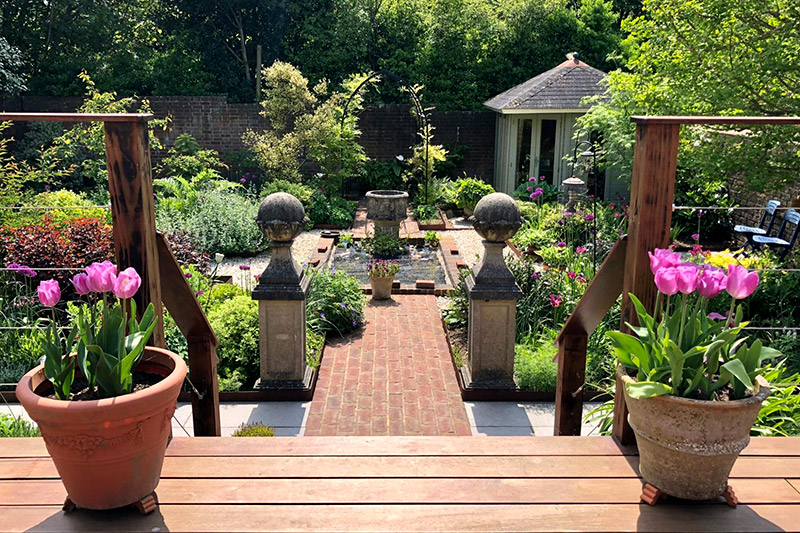
I’ll admit upfront that decking isn’t usually where my attention goes first. Most of my working life is spent thinking about soil, structure and what a border will look like in its fifth year rather than its first, so when a client asks about composite decking, my instinct used to be to steer the conversation straight back to planting. Over the last few years, though, I’ve changed my mind on that reflex, and it’s worth explaining why.
Why decking earns a place in the conversation at all
A garden isn’t just planting. It’s also the places you actually stand, sit and move through it and in a lot of British gardens, especially smaller urban plots, a deck does a job that planting simply can’t: it gives you a flat, dry, usable surface exactly where the site needs one, often bridging a level change or covering ground where nothing would thrive anyway, like deep shade under a north-facing wall or an awkward slope off the back of the house.
The old objection to decking and it was a fair one,was timber. Traditional timber decking looks lovely for about eighteen months, and then it’s a slow, steady decline: greening algae in shaded corners, splinters underfoot, boards that cup and warp, and a maintenance routine of pressure-washing and re-staining that most clients quietly resent by year three. I’ve redesigned more gardens than I can count where the deck was the single most tired-looking element, dragging down planting that was otherwise thriving around it.
That’s the specific problem composite decking actually solves, and it’s why I’ve come round to specifying it far more often than I used to.
What changed my mind
The wood-free composites on the market now are a genuinely different product to what was available a decade ago. Millboard’s boards are moulded directly from real oak, which means the grain, knots and texture are taken from an actual timber cast rather than an extruded plastic pattern, the difference is obvious the moment you run a hand across it. Because there’s no timber content in the board itself, it doesn’t rot, doesn’t need staining, and doesn’t develop the slow, sad decline that traditional decking always does.
For a plantin -focused designer, that matters more than it might seem. A deck that still looks sharp in year eight means the planting around it is being framed properly for the long term, rather than slowly upstaging a surface that’s visibly falling apart. I’d genuinely rather spec one honest, durable hard-landscaping material once than watch a garden’s overall impression erode because the deck aged faster than the borders around it.
Where I still push back
I’m not going to pretend I think decking should dominate a garden, because it shouldn’t, and this is where a lot of installations go wrong regardless of material. The mistake I see most often is a deck sized for the house rather than the garden a huge, flat rectangle that eats the majority of the plot and leaves planting as an afterthought squeezed around the edges.
My approach is close to the opposite: decking as a considered, bounded feature within a garden that’s still led by planting, not the other way round. A generously sized deck for genuine entertaining is fine. A deck that swallows the whole rear third of a garden because “it seemed easier than a lawn” is a missed opportunity, and it’s usually the client who ends up feeling that loss a year or two later, once the novelty’s worn off and they realise there’s nowhere left for anything to actually grow.
The cost conversation, honestly
Composite decking costs more upfront than timber, and I don’t think it’s useful to pretend otherwise with a client. What I do walk them through is the maintenance side of that comparison, because it’s the part that’s easy to underweight when you’re looking at two quotes side by side. Timber decking isn’t a one-off cost, it’s an upfront price plus an ongoing commitment of pressure-washing, re-staining and eventually replacing boards that have cupped, split or rotted, typically within eight to twelve years depending on exposure. A well specified composite board is designed to still be doing its job at that point, with none of the recurring maintenance weekends in between.
Framed as a single purchase, composite decking looks like the pricier option. Framed as a decade of ownership, the gap narrows considerably, and for clients who want a garden they can actually enjoy rather than one they’re perpetually maintaining, that reframing usually settles the decision on its own.
How I integrate composite decking into a naturalistic scheme
A few principles I stick to on every project where decking’s involved:
Let planting soften every edge. A hard, straight deck boundary reads as stark on its own. Planting spilling gently over the edge,grasses, low perennials, anything with a bit of movement breaks that line and stops the deck feeling like it was dropped onto the garden rather than designed into it.
Choose a tone that sits with the planting, not against it. Millboard’s collections range from pale, driftwood style tones through to much richer smoked oak shades, which genuinely changes how a deck reads against a border. A cooler, greyer tone recedes and lets naturalistic planting take the visual lead; a warmer smoked oak tone can anchor a scheme and give it a sense of permanence, particularly against darker, moodier planting palettes.
Use it to solve a real problem, not just because it’s trending. The gardens where decking works best are the ones where it’s answering an actual site issue, a level change, a shaded dead zone, a spot where nothing was ever going to thrive, rather than gardens where it’s been added simply because it looks good on a mood board. If a patch of ground would happily support planting, my default is still to plant it.
Keep the proportion in the planting’s favour. As a rough rule, if a deck is starting to feel like the main event rather than a supporting feature, it’s usually too big. A garden should read as planting first, hard landscaping second,decking included.
The honest verdict
I came to composite decking as a skeptic, and I’ve ended up as a fairly enthusiastic convert with conditions attached. It solves a genuine, long-standing problem with timber decking (the slow, ugly decline that used to make me dread specifying it), and the quality of what’s available now, particularly boards moulded from real oak rather than extruded into a generic pattern, means it can sit comfortably alongside genuinely good planting rather than competing with it.
What it isn’t, and never should be, is a replacement for planting itself. The gardens I’m proudest of are still led by what’s growing in them, the decking, when it’s there, is doing a specific job, sized honestly, and chosen in a tone that lets the borders around it do the talking. Get that balance right, and a well-chosen composite deck stops being hard landscaping you tolerate and starts being a genuine part of how the garden works.
If you’re weighing up decking for a project and want a second opinion on whether it earns its place in your specific garden,or how big it should actually be, that’s exactly the kind of conversation I have with clients across Brighton and Sussex.
