
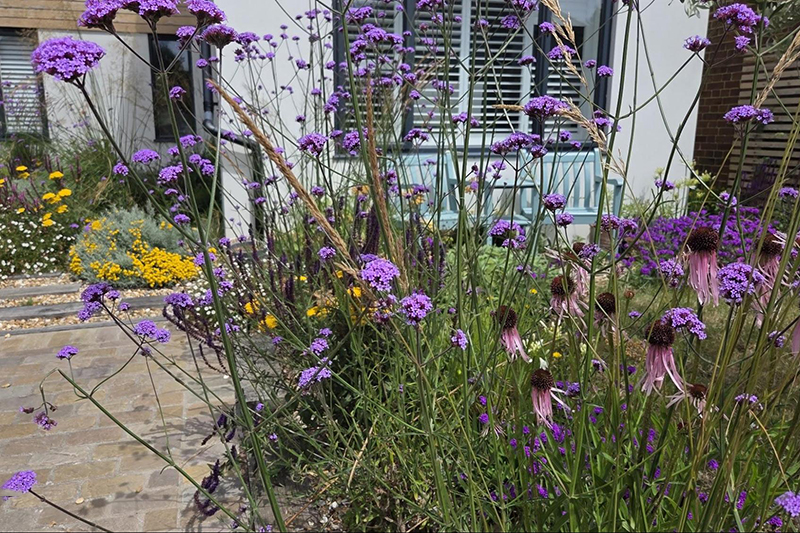
If there’s one thing I’ve learned after 20-odd years of doing this job, it’s that Brighton does not do “standard.” No two gardens are ever the same, and honestly? I wouldn’t want it any other way.
Working here means making peace with everything the city throws at you: salty wind straight off the sea, blazing sun that bounces off chalky soil, gardens the size of a postage stamp and the sea front traffic. It’s a lot. And I genuinely love it.
I’m Owen Brooks, behind Purely Planting. For me, garden design has always started with the plants. I want gardens that feel alive, not staged, the kind that shift with the seasons, pull in bees and birds, and somehow look better every year rather than worse.
Life as a garden designer in Brighton
Brighton is a proper mixed bag when it comes to gardens.
You’ve got tiny terraced plots where every single square inch has to pull its weight, generous gardens hiding behind grand Victorian and Edwardian houses, front gardens doing an awkward juggling act between “somewhere to park the car” and “somewhere that doesn’t look like a car park,” and properties out towards the edge of the city gazing up at the South Downs like they know they’ve got the best view in Sussex.
My favourite part of being a garden designer in Brighton? Finding the hidden potential in a space everyone else has written off as “too small” or “too weird a shape.”
Because a small garden doesn’t have to feel small. That’s the whole game.
It’s about thinking hard about sightlines, levels, planting, seating, and how the garden actually talks to the house. A well placed tree pulls the eye up and out. A subtle change in level tricks the brain into sensing more space than is really there. Good planting softens hard boundaries and makes a garden feel twice as deep as it actually is. It’s basically stage magic, but with soil and plants
Hove gardens: when the sea has opinions
Design gardens in Hove for long enough and you realise the sea has quite a lot to say about your planting choices, and it rarely agrees with you.
Wind off the water can be relentless, especially in an exposed front garden. Add salty air, drying conditions and blazing sun, and suddenly “just pick some nice plants” becomes a proper puzzle.
I’ve had Hove projects where getting the plant choice right made the difference between “thriving garden” and “sad, crispy garden.” One front garden I worked on sat right in the firing line of the coastal wind. The brief: make it welcoming, colourful, low-maintenance, and still leave room for the car.
The answer wasn’t to fight the conditions, it was to work with them. By choosing genuinely tough, coastal-happy plants, that garden ended up both practical and full of life. Years on, it’s still going strong. You can see how that one turned out in the Hove front garden case study.
That’s the bit of planting design in Brighton and Hove I love most: reading what a garden is telling you, and actually listening.
Small gardens need clever thinking, not more stuff
A lot of Brighton and Hove gardens are, let’s be honest, not big.
That’s not a problem. If anything, small gardens are some of the most fun to design, because every single element has to earn its place. No dead weight allowed.
I’ll use a small tree to add height without eating up ground space, or repeat the same plant through a border so it feels deliberate rather than bitty. Evergreen structure keeps things looking like an actual garden through January (rather than a sad patch of mud), while perennials bring the movement and colour once the weather warms up.
I also think a lot about the view from inside the house, the kitchen window, the upstairs landing, wherever you’ll actually be looking at the garden most of the time. A garden isn’t just for when you’re standing in it. It should be doing its job from the sofa too.
My top 5 plants for Brighton & Hove gardens
After years of trial, error, and the occasional plant fatality, these are five I keep coming back to for Sussex conditions — although, as ever, the right plant depends on the actual site in front of me.
1. Stipa tenuissima — Mexican feather grass
An absolute favourite for naturalistic planting. Its fine, flowing foliage catches the tiniest breath of wind and gives a border a lovely sense of movement. Loves a sunny, well-drained spot, and looks brilliant planted in generous drifts. Gives a garden that relaxed, slightly wild energy I’m always chasing.
2. Verbena bonariensis — tall verbena
Tall, airy, and brilliant at adding height without turning into a heavy block of planting. Those purple flowers float above everything else from summer into autumn, and the bees and butterflies absolutely cannot get enough of it. Perfect when you want a scheme to feel abundant without feeling crowded.
3. Pittosporum tenuifolium
The reliable friend of the evergreen world. Gives year-round structure and copes well with sheltered coastal conditions. It also takes pruning and training happily, so it’s brilliant for smaller gardens where you need planting that behaves itself.
4. Allium
Pure drama, in the best way. They punch up through other planting in late spring with those iconic spherical flowers, and even once the colour fades, the seed heads keep the architectural interest going. Planted in groups, in a naturalistic scheme, they’re unbeatable.
5. Amelanchier
If there’s room for a small tree, this is usually the one I reach for. Spring flowers, fresh new foliage, berries, and knockout autumn colour — it earns its keep across every season, without ever overwhelming a smaller space. Exactly what I want from a garden plant.
Why I’m obsessed with natural planting
Ask me what my favourite style of garden is, and I’ll probably say: one that doesn’t look like anyone’s tried too hard.
Which is not the same as “accidental,” by the way. Quite the opposite, a natural-looking garden usually takes far more thought than a rigid, formal one.
I like planting that moves, changes, and surprises you. Grasses catching the wind. Seed heads standing proud through winter. Bulbs popping up out of nowhere in spring. Perennials slowly filling out a border like they own the place.
I like repetition without uniformity. I like plants the bees and butterflies actually use, not just admire. And I really like gardens that look better five years after planting than they did the day we finished.
That’s genuinely what Purely Planting is about.
A few Brighton & Hove gardens I’ve loved working on
The best bit of this job is that every project is a completely different puzzle.
I designed a front garden in Ovingdean where planting alone gave the property a totally new identity. I’ve worked on suburban gardens in Hove, where the challenge was packing a generous, layered scheme into a fairly tight footprint. I also designed a Hove garden built around a swimming pool, where the planting had to soften all that hard architecture and pull the whole space back together.
Then there are the quieter, more naturalistic gardens I get to design out towards the South Downs and the wider Sussex countryside, you can see a good spread of it all in the full case studies gallery.
Every single one has taught me something. Which, twenty years in, is honestly still the reason I love doing this.
What actually makes Purely Planting different
There are plenty of talented garden designers around Brighton and Sussex, I’m not pretending otherwise.
What sets Purelyplanting apart is how seriously I take horticulture, not just the layout on paper. Design and planting aren’t two separate jobs for me, they’re the same conversation.
I think about the bones of the garden, sure. But I’m also thinking about what’s happening underneath and in between all of that structure. Will the plants actually thrive here? What does this border look like in the middle of January, when nobody’s pretending it’s pretty? What happens in five years once everything’s matured? Will it pull in the wildlife? Will it still work when you’d rather be on the beach than out there weeding every weekend?
Those questions matter just as much as the initial sketch, sometimes more.
Designing gardens that actually belong in Brighton & Hove
A Brighton garden shouldn’t try to be a Cotswolds garden. A Hove garden battered by sea wind needs to respond to that, not ignore it. And a compact urban plot shouldn’t be designed like a sprawling country estate that’s shrunk in the wash.
The best gardens respond to where they actually are. That might mean plants that shrug off coastal exposure, making the absolute most of a sun-trap courtyard, working with chalky soil instead of against it, or layering planting cleverly through a small space so it never feels cramped.
Honestly, that’s where garden design gets genuinely interesting for me.
A garden is never really “finished”
My favourite part of the job might actually be what happens after the last plant goes in.
Planting day is exciting, but it’s only the opening scene. Plants grow. Trees put on height. Birds turn up uninvited (the good kind of uninvited). The light shifts through the year. Seasons roll round again.
A good garden develops its own personality over time, which is exactly why I’m such a naturalistic planting evangelist, and exactly why planting sits at the heart of everything at PurelyPlanting
I’m not interested in gardens that only look good in the “after” photo on planting day. I want gardens people actually live in. Gardens with character. Gardens that keep changing. And, ideally, gardens that make you want to spend just a little more time outside than you planned to.
Garden designer, Brighton & Hove
If you’re weighing up a garden change anywhere in Brighton, Hove, or the wider Sussex area, I’d genuinely love to hear what you’re thinking about.
Maybe it’s a small garden that’s not pulling its weight, an exposed Hove plot where nothing seems to survive more than a season, or a bigger Brighton garden that needs a proper rethink from the ground up. Whatever the size of the puzzle, I’m in.
At Purely Planting, I bring garden design and specialist planting knowledge together to create gardens that feel natural, work hard for you, and only get better with age. Have a look at the garden design process and packages, browse a few more case studies, or just get in touch and let’s talk about your garden.
I also cover a good chunk of the wider region beyond Brighton and Hove,including the borders of Surrey and Kent, see the full areas I work in if you’re a little further out.
Purely Planting garden design and planting across Brighton, Hove, Lewes, Sussex and beyond.
